From the Miller (Michael J.) Civil Rights Collection. A record of race-related violence in Mississippi from January 1961 to February 1964, with a brief paragraph for each incident. Illustrated.
From the Miller (Michael J.) Civil Rights Collection; In this memo, lawyers for the Mississippi Freedom Democratic Party present and address questions that were raised regarding the legality of the 1964 Congressional Challenge. The authors cite...
From the Miller (Michael J.) Civil Rights Collection. Curriculum suggestions for prospective freedom school teachers. Table of contents delineates three distinct curriculum areas: academic, citizenship, and recreational and artistic; document...
From the Miller (Michael J.) Civil Rights Collection. An address to SNCC staff members and/or civil rights workers and a list of approximately 200 questions about Mississippi history and government. The questions are designed for use as part of the...
From the Miller (Michael J.) Civil Rights Collection. Information packet for prospective contributors to COFO's freedom school program; consists of the original proposal for the program, written by Charlie Cobb.
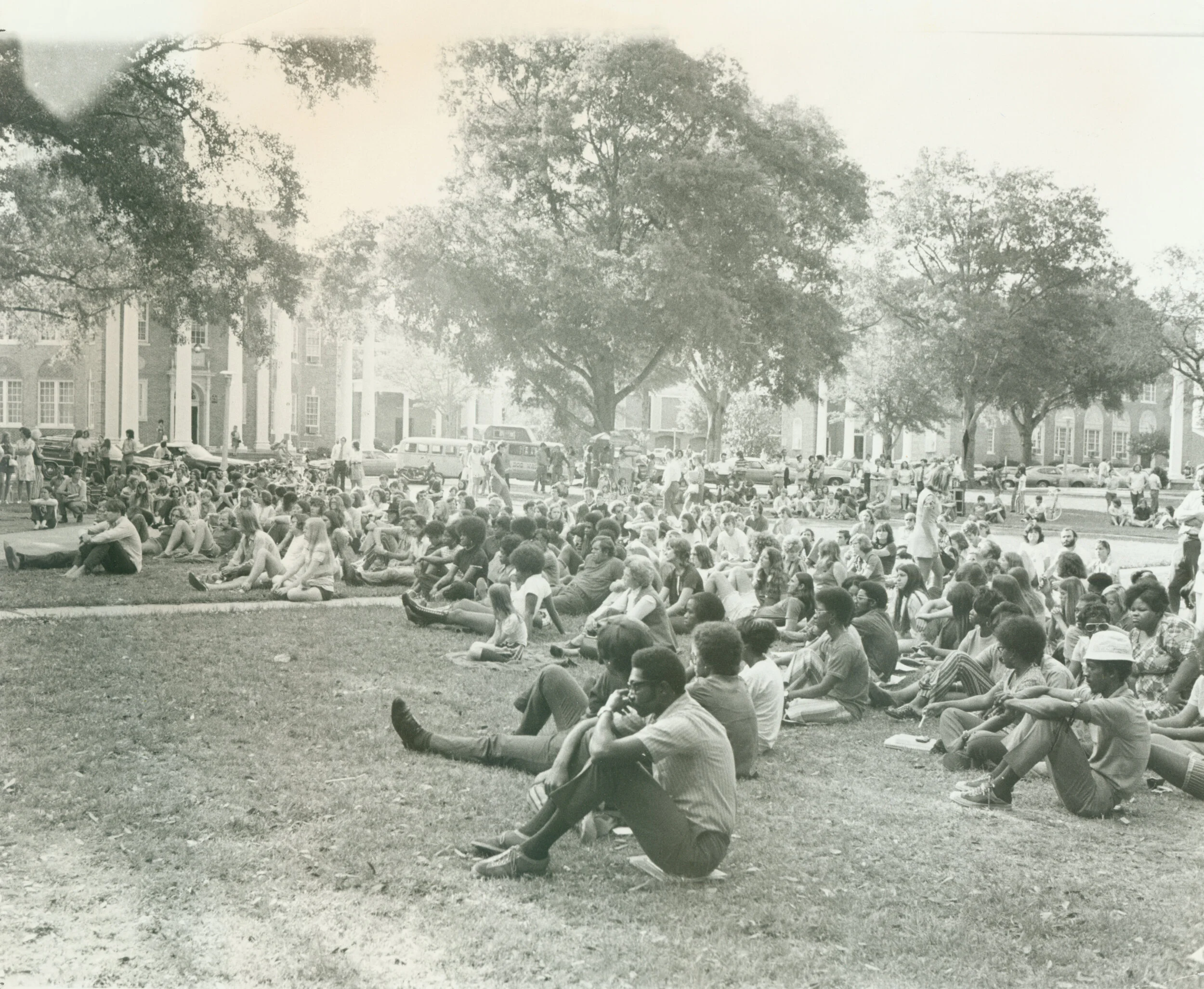
Photograph of the 1971 Afro-American Cultural Society. Pictured left to right: 1st row: Dr. Robert D. Smith (advisor), Cynthia Barnes, Mattie Coleman (parliamentarian), John Price (president), Lettie Evans (secretary), Robert Williams, Samson Byrd;...
From the Miller (Michael J.) Civil Rights Collection; Newsletter from Amite County; discusses education-centered civil rights initiatives, including an attempt to remove the principal of Liberty's Central High School.
From the Miller (Michael J.) Civil Rights Collection; Newsletter from Amite County; discusses trial of white men for a racially-motivated beating, and local agriculture and federal farm subsidies.
A collection of interviews with African-Americans of the Mississippi Gulf Coast, circa twentieth and early twenty-first centuries, who knew Colonel John Robinson, an African-American pilot who was tapped by Ethiopian Emperor Haile Sellassie in the...
From the Miller (Michael J.) Civil Rights Collection; With amendments attached to the legislative bill, the future Civil Rights Act of 1964 passes the United States Senate, but still requires concurrence from the United States House of...
From the Miller (Michael J.) Civil Rights Collection; The booklet is supplementary reading material for one of the Student Nonviolent Coordinating Committee's (SNCC) adult literacy projects. The text combines many excerpts from the Old Testament...
From the Miller (Michael J.) Civil Rights Collection; Appendix C explains the history and platform of the Mississippi Freedom Democratic Party (MFDP), lists the executive committee members, and sets out a plan for the Congressional challenge. ...
From the Miller (Michael J.) Civil Rights Collection; Appendix A describes the history of political disenfranchisement of African Americans in Mississippi in detail and notes Civil Rights movement activities that have been taken to restore the...
From the Miller (Michael J.) Civil Rights Collection. Document enumerating legal restrictions on federal district judges in the South. The document advocates supplementing with a special judgeship for civil rights cases only.
From the Miller (Michael J.) Civil Rights Collection. Reprint of Stokely Carmichael's article, What we want, which had been published in The New York Review of Books. Carmichael discusses Black power, the Student Nonviolent Coordinating Committee...
From the Miller (Michael J.) Civil Rights Collection; Mrs. Walker's autobiography was originally published in May of 1965 in The Movement, 1: (2)" In it, she describes her early life and employment history in Mississippi. She laments losing her...
From the Miller (Michael J.) Civil Rights Collection; This report gives many accounts of bombings, shootings, and assaults perpetrated by the Ku Klux Klan in Natchez between the years of 1963 and 1965. It also mentions a court injunction placed on...
From the Miller (Michael J.) Civil Rights Collection. Document prepared for civil rights workers and their families and friends. It lists the legal justifications for federal intervention in civil rights disputes and cites specific legislation that...