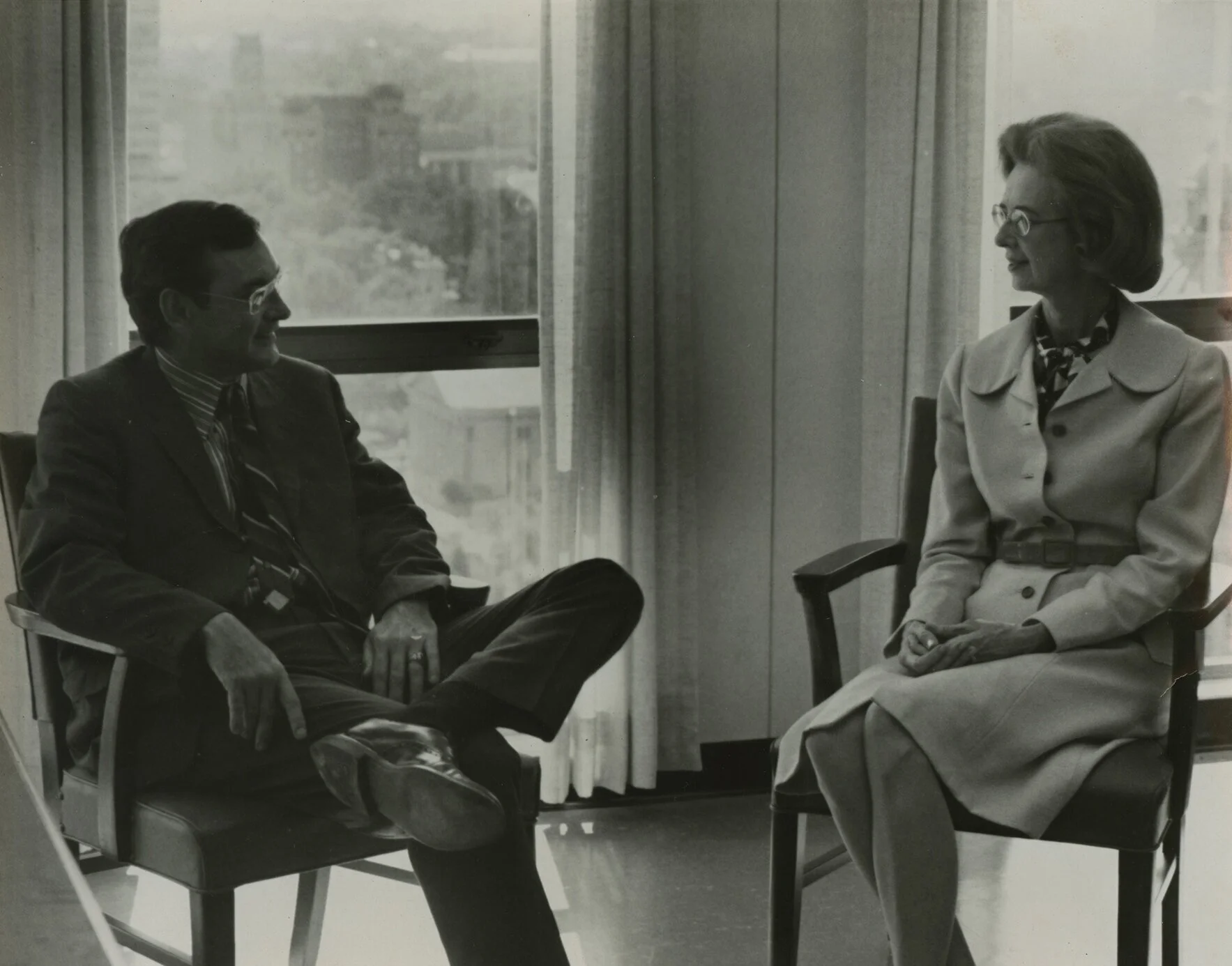
Oral history.; Interview conducted on January 23, 1973 with Mr. William Dukes in his office in Gulfport, Mississippi. Dukes was born in the Sullivans' Hollow area near Raleigh, in Smith County, Mississippi on January 15, 1927. After his discharge...
Oral history.; Interview conducted on May 17, 1972 with Associate Justice Thomas Pickens Brady, of the Supreme Court of Mississippi in his chambers in Jackson, Mississippi. This is the second part of an interview conducted on March 4, 1972 with...
From the AAEC Editorial Cartoon Collection; Cartoon by Paul Carmack. A personified scroll of paper labeled "Court packing proposal" stands on a ladder that leans against the facade of the U.S. Supreme Court building. The scroll, with a paint brush...
From the Campbell (Will D.) Papers; Copy of a typewritten letter from Will D. Campbell to Rawson Woods, dated March 14, 1967, in which Campbell discusses the National Catholic Conference for Interracial Justice. The organization lost...
Transcribed copy of a letter from Zoya Zeman to her father dated July 7, 1964, in which she discusses Ross Barnett and other Southern politicians and their influence on the racial attitudes of many southern whites. She goes on to say that people...
From the AAEC Editorial Cartoon Collection; Cartoon by Jon Kennedy. President Lyndon Johnson, looking dismayed, is portrayed as an automobile mechanic working on the engine of a high performance race car labeled "Lyndon Johnson special." A number...
From the AAEC Editorial Cartoon Collection. Cartoon by Eldon Pletcher. Hubert Humphrey is on a sidewalk holding a sign that reads, "I'm my own man." On the wall beside him, his shadow is in the shape of Lyndon Johnson.
A collection of interviews with African-Americans of the Mississippi Gulf Coast, circa twentieth and early twenty-first centuries, who knew Colonel John Robinson, an African-American pilot who was tapped by Ethiopian Emperor Haile Sellassie in the...
A collection of eight interviews with participants in the Mississippi civil rights movement. The people interviewed discuss how they came to participate in the civil rights movement, their various activities, including voter registration, Freedom...
A collection of ten interviews with participants in the Mississippi civil rights movement. The people interviewed discuss how they came to participate in the civil rights movement, their various activities, including voter registration, Freedom...
From the McCain (William D.) Pamphlet Collection; The pamphlet discusses the influence the National Association for the Advancement of Colored People (NAACP) has on U. S. Congressional legislation, and provides a scoreboard of how the U. S. 84th...
From the AAEC Editorial Cartoon Collection; Cartoon by Ed Valtman. Lyndon Johnson is escorting a man labeled "Businessmen" toward two doors, both closed. Johnson has twisted the arm of the man behind his back. The door on the left is labeled...
From the AAEC Editorial Cartoon Collection; Cartoon by Vic Runtz. Fidel Castro is shown smoking a cigar labeled "Influence." An arm labeled "Brazil" uses scissors to cut the cigar in half at the same time that a thrown rock hits Castro on the back...
Oral history.; Mr. Alton G. Bankston was born outside of Laurel, Mississippi on June 5, 1941. Mr. Bankston majored in political science and history at Jones County Junior College and attended the University of Southern Mississippi. In 1963 he...
Oral history.; Two interviews conducted on April 1, 1993 and January 6, 1995 with Ariel Barnes (born 1917). Mrs. Barnes was born in Forest, Mississippi, but moved to Hattiesburg shortly after. She attended Alcorn University, where she earned a...
Oral history.; Mr. George A. Stevens was born in 1910 in Forrest County, Mississippi. He attended Hattiesburg public schools but graduated from high school in Anthony, New Mexico. Mr. Stevens returned to attend The University of Southern...
Oral history.; Discusses her father, Erle Johnston. Describes his relations with Ross Barnett and his work with the State Sovereignty Commission, which she denies was ever a spy organization.
Oral history.; Discusses Clarence Magee's family, his responsibilities on the farm, and first memories of racism. Talks about the African American schools around Columbia, Mississippi. Describes his attempts to register to vote in Hattiesburg and...