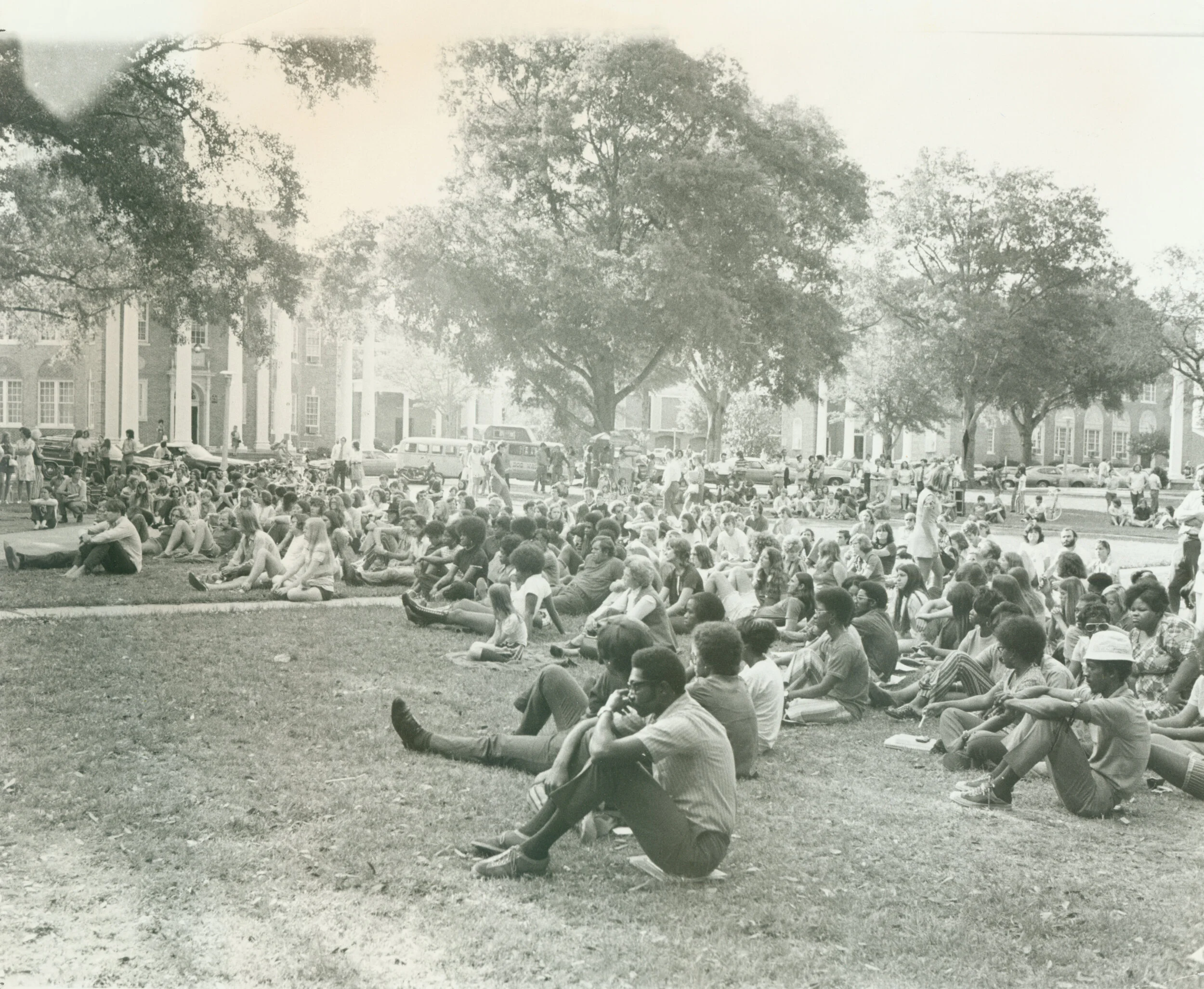
A collection of interviews with African-Americans of the Mississippi Gulf Coast, circa twentieth and early twenty-first centuries, who knew Colonel John Robinson, an African-American pilot who was tapped by Ethiopian Emperor Haile Sellassie in the...
From the AAEC Editorial Cartoon Collection. Cartoon by Richard Locher. Two rats are labeled "Violence" and "Terrorism." They are eating a globe of the Earth as if it were food. One is eating in the area of Eastern Europe/Soviet Union and the other...
A collection of eight interviews with participants in the Mississippi civil rights movement. The people interviewed discuss how they came to participate in the civil rights movement, their various activities, including voter registration, Freedom...
From the AAEC Editorial Cartoon Collection; Cartoon by Ed Valtman. The upper floors of the United Nations building are shown, with a number of people hanging out the windows. One person, labeled South Africa, has apparently been pushed out of a...
From the Merritt Mauzey Papers.; Small ink sketches of a of a hippopotamus in Africa and mammal in Africa created by Merritt Mauzey [circa 1972]. Sketch one is 3" x 5" and sketch two is 3.5" x 5.5"
Oral history.; Interview conducted on March 24, 1972 with Dr. William Penn Davis at his home in Jackson, Mississippi. Davis was born in Union County, Mississippi on August 5, 1903. He received a Bachelor of Arts degree from Mississippi College in...
Oral history.; Interview conducted on May 18, 1972 with Ms. Ruby Magee at College Hall at the University of Southern Mississippi. Magee was born in 1940 in Tylertown, Mississippi. In 1962, she received a BA in history and political science from...
Oral history.; Interview conducted on July 12, 1973 with Mr. Jerry Clower at his office in Yazoo City, Mississippi. Clower was born in 1926 at Route Four, Liberty, Mississippi. After graduating from high school, he joined the U.S. Navy. On...
Oral history. Interview conducted on March 4, 1972 with Associate Justice Thomas Pickens Brady, of the Supreme Court of Mississippi in his chambers in Jackson, Mississippi. Brady was born on August 6, 1903, in New Orleans, Louisiana. He...
From the Map Collection. Map of the western hemisphere, including North and South America. Map also shows a small portion of Western Europe and Africa. [Maps of the same name by Fer previously published or issued in 1699 and 1705.]
From the Political Campaign Collection. Flyer advertising a showing of films of Liberia, Africa, by Professor J. Rockmore, following his return from a visit to Africa.
A collection of interviews with African-Americans of the Mississippi Gulf Coast, circa twentieth and early twenty-first centuries, who knew Colonel John Robinson, an African-American pilot who was tapped by Ethiopian Emperor Haile Sellassie in the...
A collection of eight interviews with participants in the Mississippi civil rights movement. The people interviewed discuss how they came to participate in the civil rights movement, their various activities, including voter registration, Freedom...
A collection of ten interviews with participants in the Mississippi civil rights movement. The people interviewed discuss how they came to participate in the civil rights movement, their various activities, including voter registration, Freedom...
Oral history.; Dr. Antone Walter Tannehill, Jr., was born May 22, 1929, in New Orleans, Louisiana, but grew up in Hattiesburg, Mississippi. He attended Vanderbilt University and Duke University Medical School. He served an internship at the...
Oral history.; Interview conducted on September 20, 1979 with Dr. Dewey Lane at the Robinson Lane Surgical Clinic in Pascagoula, Mississippi. Lane was born on September 27, 1934 in Starkville, Mississippi. He attended Vanderbilt University from...
Oral history.; Page discusses his family, his experiences as a black physician, the civil rights movement, his work in state politics, and the Mississippi Humanities Council.